
The car phone – from symbol of power to marker of time

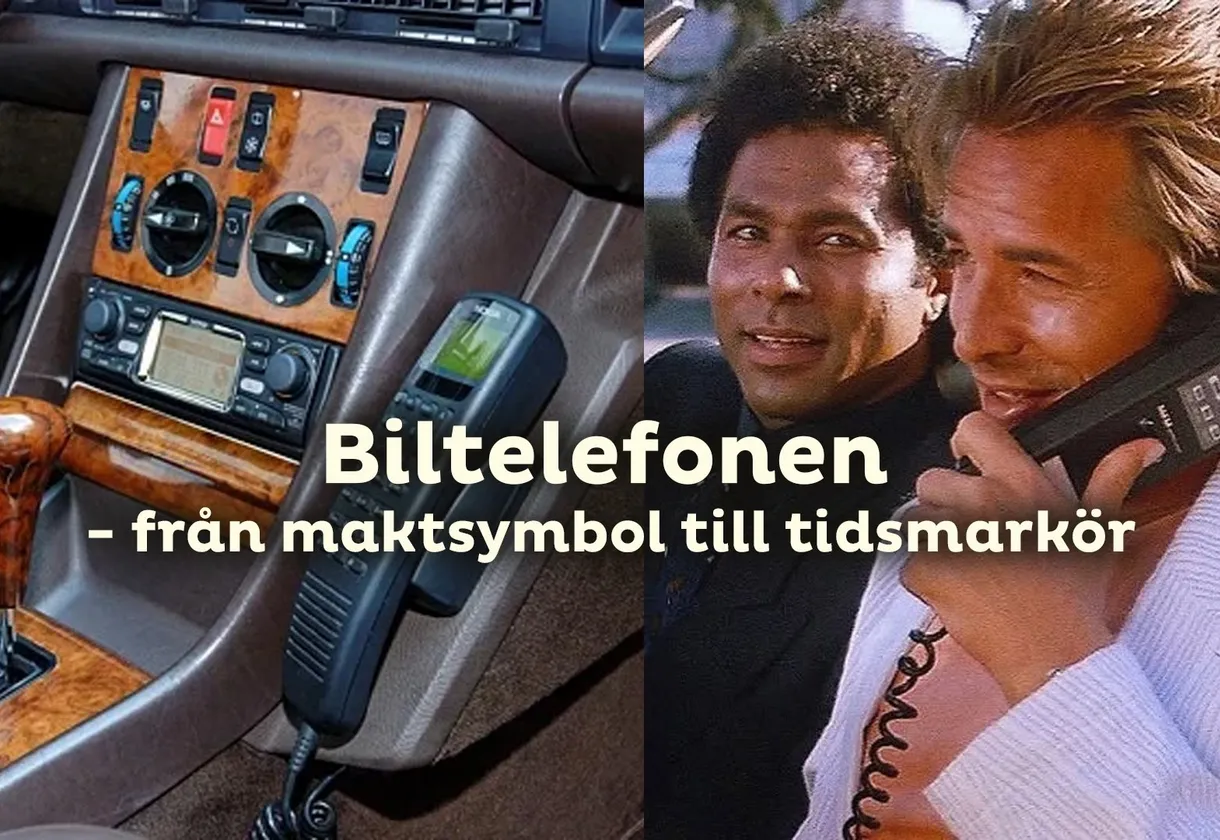
When the telephone was a symbol of power
In the 1980s, the car phone was far more than just a practical accessory. Spending over 20,000 kronor to have a phone installed in one’s car was a clear way to signal that one had both money and business to attend to.
The technology was expensive, coverage was limited, and the equipment was bulky. Yet, suddenly, there was no need to wait until returning to the office. Decisions could be made from the highway, and business matters discussed between meetings. In some truly high-end Mercedes-Benz models, the concept went even further, featuring fax equipment that could transform the back seat into a mobile office.
In other words, the car phone was both ahead of its time and a major status symbol.
From 36 kilos to the center console
The story began much earlier. Car radiophones existed as far back as the 1940s, but the equipment could weigh tens of kilograms and required extensive installation.
For the Nordic region, the NMT system—launched in 1981—marked the major breakthrough. At that time, the phone still naturally belonged in the car; for instance, Nokia’s Mobira Senator was launched in 1982 as a dedicated car phone.
As the technology shrank, car manufacturers soon realized that the phone didn't just have to be mounted in the vehicle—it could be integrated into the cabin itself. And that is where the truly memorable examples begin.
Mercedes-Benz – the rolling office
Few brands are as strongly associated with the car phone as Mercedes-Benz. In the 1980s and 90s, the handset in the center console was practically a symbol of success. Images of a young Michael Schumacher with the phone in his C124 capture the spirit of the era quite well.
It is perhaps most at home in the S-Class W140. A phone, wood trim, electric seats, and—ideally—a V12 under the hood: it doesn’t get much more "executive car" than that.
BMW 7-serie E38 – The perfect accessory of the 90s
In the BMW E38, the integrated phone looks almost as if the entire center console was designed around it. The model could be ordered with various Motorola- and Siemens-based systems, and in later cars, the integration became increasingly sophisticated.
A 750iL with a V12 engine, dark wood trim, and a telephone handset between the front seats is about as close to the pinnacle of 1990s luxury as you can get on four wheels.
Lexus LS400 – Japanese luxury on its own terms
Lexus also recognized the value of being reachable from the car. The LS400 could be equipped with integrated phone solutions that fit perfectly with the brand's ambition to challenge Mercedes and BMW.
The result was perhaps less ostentatious than that of the German rivals, but all the more discreet and functional—entirely in keeping with the rest of the car.
Jaguar XJ – preferably with wood, leather, and Motorola
Naturally, Jaguar offered a telephone option as well. For the X300 generation of the XJ, telephone installations using Motorola equipment were available; Jaguar’s own documentation details features such as specific wiring harnesses and a handset holder mounted on the center console.
The subsequent X308 model could also be equipped with integrated telephone solutions, including systems based on the Motorola StarTAC.
Aesthetically, the combination is hard to beat. A telephone handset alongside chrome, Connolly leather, and glossy wood veneer feels like something from an era before people "took Teams meetings from the car."
You made a call. Preferably an important one.
Volvo S80 – The phone becomes truly integrated.
When the first-generation Volvo S80 arrived in 1998, the concept took another step forward. Volvo introduced the model with a fully integrated GSM phone, with the system forming part of the car's own electronics.
A hands-free function was available, of course, but if one wanted to have a private conversation, it was still possible to lift a real handset from the armrest. It is hard to find a detail that better encapsulates the optimism surrounding the turn of the millennium.
Porsche 996 – old and new at the same time
I can’t talk about car phones without mentioning the Porsche 996, which is also a great example of how long that old technology lingered. For quite some time, the model stubbornly retained both a cassette player and a built-in phone among its equipment options. My first 996 had both, and I actually planned to hook the phone up using a SIM card adapter. Just imagine how cool it would have been to sit at a red light chatting on a corded phone.
These were two features that quickly began to feel outdated as the 2000s got underway—but which today actually give the cabin an even more charming, period-authentic feel.
Then the mobile phone caught up
During the 1990s, mobile phones shrank at a rapid pace. Devices that, just a few years earlier, required a transmitter unit in the trunk could suddenly fit in a shirt pocket.
Car manufacturers tried to keep up with these developments. Around the turn of the millennium, instead of fully fixed phones, models began using detachable handsets—such as the Motorola StarTAC and Timeport—that remained deeply integrated with the vehicle.
Mercedes, for instance, offered an integrated Timeport system for the 2001 model year.
But the direction was clear. First came the cradle for your own mobile phone. Then Bluetooth. Next came Apple CarPlay and Android Auto, and finally today’s systems, where the phone itself has all but disappeared from the equation.
In just a few years, the car phone went from being perhaps the vehicle's most prestigious optional extra to feeling completely prehistoric.
At least it was cooler before
In purely practical terms, today’s solutions are superior in almost every way. Moreover, many vintage car phones can no longer be used because the mobile networks they were built for have been shut down.
But in a well-preserved car from the 90s, the handset has become something else: a marker of its time.
Just like the cassette player, the CD changer, or an old Becker stereo, it speaks of an era when advanced technology wasn't meant to be hidden. It was meant to be seen.
And saying "call Anders" to a screen will never quite compare to opening the armrest in a 750iL, lifting the handset, and actually making a call from the car.
Things might not have been better back then. But they were definitely cooler.
Tomas Jönsson, Marketing manager
What do you think about car phones? Cool or outdated? Did we miss any models?
Let us know in the comments below!
Ericsson hotline