
G-Wagen — the classic with a thousand faces

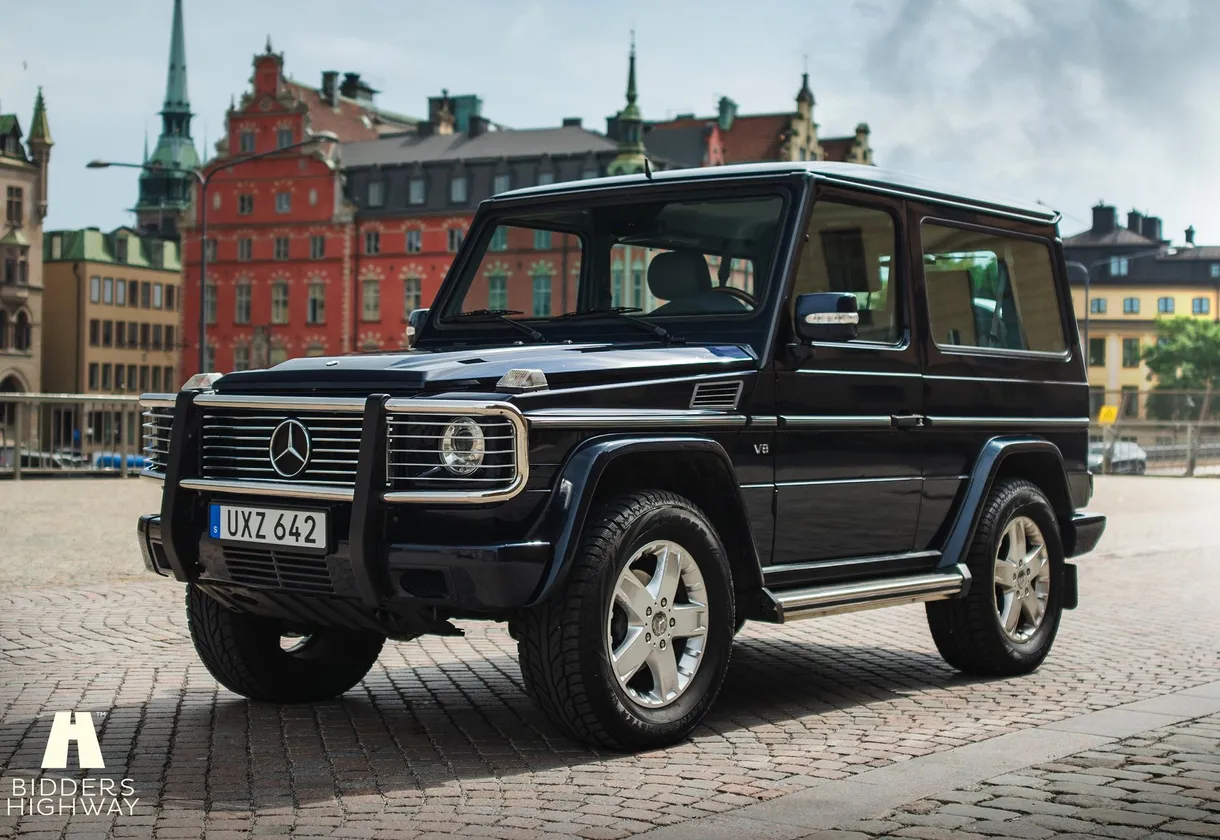
From military vehicle to luxury off-roader, via youngtimer to "simply just cool"
Few cars have made the journey of the Mercedes-Benz G-Class (G-Wagen, "Geländewagen" — German for "off-road vehicle"). It was born as an unpretentious military jeep, became one of the world's most exclusive SUVs, and today feels just as at home outside a villa in Djursholm as on a farm. Throughout, the body has barely changed — that's the whole point.

From an Iranian order to a luxury icon
The G-Wagen was developed by Mercedes-Benz together with Austria's Steyr-Daimler-Puch, originally commissioned by the Shah of Iran (who sat on the Mercedes board) for military use. The car launched in 1979 as the W460 — a spartan, extremely capable off-roader with solid axles front and rear, three locking differentials and a ladder-frame chassis built to never give up.
What makes the G-Wagen unique is that the model was never replaced — it was continuously developed. The 1979 silhouette lives on almost unchanged in today's cars, while everything beneath the skin has been modernised generation by generation:
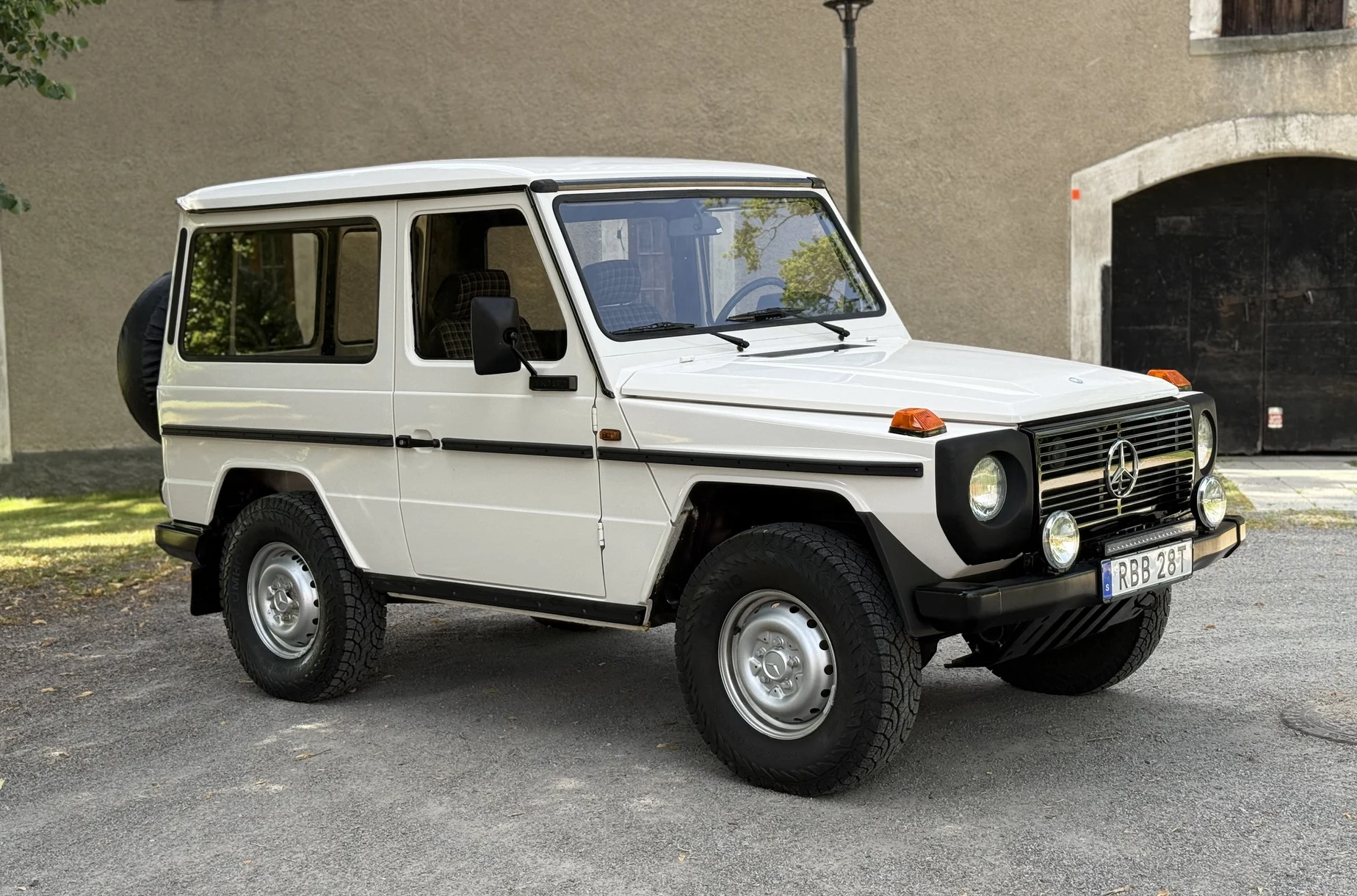
- W460 (1979–1991) — the original. Simple, rugged, sparsely equipped in military fashion.
- W461 (1992–present) — the "working" version, still in production for military, rescue services and enthusiasts who want pure off-road spirit (e.g. 240 GD, 250 GD).
- W463 (1990–2018) — the civilian, luxurious version. This is where the G-Wagen starts becoming a status symbol: leather upholstery, climate control, and later AMG engines (G500, G55 AMG, G63 AMG).
- W463 second generation / "W463A" (2018–present) — an entirely new platform beneath the same iconic sheet metal: independent front suspension (for the first time in 39 years), a modern array of screens and assistance systems.
- G 580 with EQ Technology (2024–present) — the electric G-Class. Four motors (one per wheel), same silhouette, new drivetrain — and a clear sign that the model intends to live on for decades to come.

Why it's still hot
The G-Wagen has gone from working tool to cultural icon without ever ceasing to be a true off-roader. It's one of the few cars that is simultaneously:
- A Hollywood and hip-hop symbol — seen as often outside nightclubs as in the Sahara.
- Value-secure — older W460/W461 models and early W463s have risen sharply in price in recent years; the new price today starts at around SEK 1,499,000, while used examples trade between roughly SEK 300,000 and SEK 2,000,000+ depending on condition, model year and engine.
- Genuinely versatile — three locking differentials and low range make it one of the most capable production off-roaders ever built, while modern versions are fully equipped luxury cars.
- Built to last — the frame construction and simple mechanics (especially on older W460/W461 models) make the car unusually repair-friendly compared with other luxury cars in its class, even if spare parts are expensive.
Build quality — what makes it "the real deal"
The G-Wagen is (still) built by hand at Magna Steyr in Graz, Austria — the same venerable workshop that has always built the car. It shows:
- Steel ladder frame, same basic principle since 1979 — extremely torsionally rigid, made to withstand off-road use and heavy loads.
- Straight, upright body panels without unnecessary curves: easier to repair, but also a surface heavily exposed to weather, salt and stone chips.
- Simple, robust electronics on older cars — the W460/W461 has few electronic connections compared with contemporary luxury cars, which makes them popular among hands-on owners.
- Solid drivetrain but expensive to service — differentials, transfer case and steering box are robust but costly once they wear, and spare parts prices match the car's prestige level.

What should you look out for when buying?
We've cross-checked against several independent buyer's guides (including minbilkoll.se and bilguiden.nu) to complement our own experience of selling G-Wagens at auction:
- Rust is the big culprit. The frame, door sills, the rear door under the spare wheel and areas around the windshield are known risk zones — especially on older examples that have seen winters on salted Swedish roads. A cosmetically pristine car can hide expensive bodywork issues. Lift the car and inspect the frame and crossmembers from underneath — surface rust is normal on older cars, but through-rust in the frame is a deal-breaker.
- Test the differential locks and low range during a test drive. Locks that don't engage, or warning lights that don't illuminate, can indicate costly faults in the vacuum or electronic control systems.
- Listen for play in the steering and vibrations in the drivetrain at 70–90 km/h — ball joints, steering dampers and universal joints are known wear points on a heavy car with rigid axles.
- Request a full service history. For petrol/diesel versions: timing chain-related maintenance and oil changes in the transfer case and differentials. For the electric G 580: battery health and warranty status.
- Check how the car has actually been used. A G-Wagen driven hard off-road or used for towing without proper servicing is often a more expensive purchase than a well-maintained car with a higher price tag.
- Expect high running costs regardless of model year — insurance, servicing and spare parts are on an entirely different level than for a regular SUV. That's the price of the prestige.
In short: a cheap G-Wagen without paperwork is almost always more expensive in the end than a pricier car with complete history.
G-Wagens with us — sold and ongoing
We've sold several G-Wagens over the years, spanning a wide range of ages and specifications:
| Car | Completed | Hammer price | Reserve price | Number of bids |
|---|---|---|---|---|
| 2002 Mercedes-Benz G 400 CDI SWB (UJF492) | 1 Jul 2026 | SEK 305,000 | SEK 302,500 | 20 |
| 2004 Mercedes G400 (short) | 14 Jul 2022 | SEK 354,000 | SEK 325,000 | 38 |
| 2000 Mercedes G 500 | 11 Oct 2022 | SEK 352,500 | SEK 340,000 | 9 |
| 2002 Mercedes-Benz G 500 | 28 Jun 2023 | SEK 277,500 | SEK 275,000 | 30 |
| 1991 Mercedes-Benz G 230 | 22 Mar 2022 | SEK 292,000 | SEK 270,000 | 61 |
Live and upcoming right now:
- 🔴 LIVE: 1987 Mercedes-Benz 240 GD 461 (YLE871) — auction in progress, ends 13 September 2026.
- 🕐 Coming soon: 1981 Mercedes-Benz 240 GD (RBB28T) — ends 19 September 2026.
- 🏷️ Classified listing (fixed price): 2025 Mercedes-Benz G 580 Manufaktur, SE-spec — the electric generation, listed as a classified ad now.

Sources for the buyer's guide section: minbilkoll.se ("Mercedes-Benz G-Class: buyer's guide, common faults and price 2026") and bilguiden.nu ("Mercedes-Benz G-Class (SUV) – Review, price & insurance 2026").