
Chevrolet Corvette — The sportscar of America

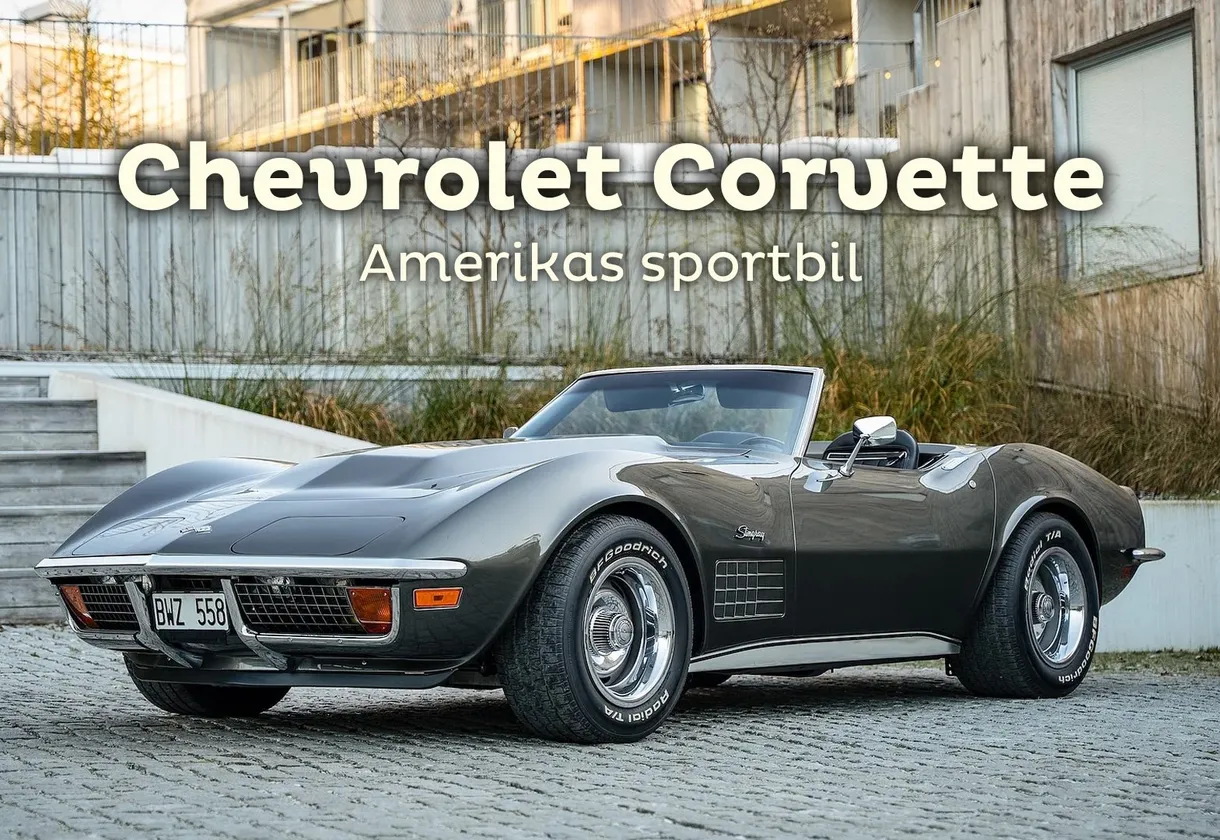
America's only real sports car
The Chevrolet Corvette is America’s answer to the European sports car tradition—and it has been making a powerful statement since 1953. What began as a somewhat tentative roadster featuring the "Blue Flame" six-cylinder engine and Powerglide automatic transmission quickly evolved into a thoroughbred V8 sports car capable of challenging the best from Europe. Across seven generations, the Corvette has delivered a level of performance for the price that few can match.
Generations of Chevrolet Corvette
C1 (1953–1962)
The first Corvette—a sculptural beauty in fiberglass. Early C1s with the inline-six engine are rare. It received its V8 in 1955, and everything changed. The 1961–1962 models, featuring the "ducktail" rear and the "Fuelie" engine delivering up to 360 hp, are the most sought-after—rare and expensive today.
C2 Sting Ray (1963–1967)
Arguably the most beautiful American car ever made. The 1963 Split-Window Coupe is the crown jewel—the split rear window was produced for only one year. 327 and 427-cubic-inch Big Block engines deliver raw power. The C2 is highly prized, and its value is steadily rising.
C3 (1968–1982)
The "Coke-bottle" shape and T-top roof make the C3 instantly recognizable. Early C3 models with the Big Block 427/454 are powerful, whereas later versions (1975+) were hampered by emissions regulations. The Stingray badge was dropped in 1976. The C3 is the most common Corvette on the market and often the most affordable entry point.
C4 (1984–1996)
Digital instrumentation and modern technology. Long undervalued, the ZR-1 (1990–1995)—with its LT5 DOHC V8 (375 hp, developed with Lotus)—is a serious collector's item. Standard C4s offer exceptional value.
C5 (1997–2004)
An all-new platform featuring a significantly stiffer chassis (hydroformed frame rails) and the LS1 engine, which laid the foundation for GM’s modern small-block era. The C5 Z06 (2001–2004)—equipped with the LS6 engine (producing 385–405 hp) and lightweight components such as a titanium exhaust system and a fixed-roof coupé body—is a major favorite and ranks among the best performance-per-dollar cars of all time. The standard C5 Coupé and Convertible remain affordable, excellent entry points into the world of automotive enthusiasts.
C6 (2005–2013)
Sharper styling, exposed headlights (for the first time since the C2), and even better chassis dynamics. The C6 Z06 (2006–2013) featured the new LS7 (7.0 liters, 505 hp)—the last naturally aspirated pushrod engine in the Z06 series. The pinnacle of the generation was the C6 ZR1 (2009–2013) with its supercharged LS9 (638 hp), which challenged European supercars at a fraction of the price and set the production-car record at the Nürburgring at the time.
C7 (2014–2019)
The Stingray name returned, featuring sharper styling and a significantly more capable chassis. The C7 Z06 (supercharged LT4, 650 hp) and the extreme C7 ZR1 (755 hp, setting a new top-speed record for a production Corvette) established new performance benchmarks. The Grand Sport version combined the Z06 chassis with a naturally aspirated engine to create a balanced all-rounder.
C8 (2020–)
The major paradigm shift: for the first time, the Corvette adopted a mid-engine layout, dramatically altering its driving dynamics and placing it in a new league alongside European supercars. The C8 Stingray, the Z06 (featuring a naturally aspirated flat-plane crank V8 producing 670 hp), and the upcoming all-wheel-drive hybrid E-Ray demonstrate the model's rapid evolution. These cars remain rare on the Swedish used market due to their recent arrival.
Chevrolet Corvette on Bidders Highway
17 units sold at an average price of SEK 379,000—but with a huge range, from SEK 52,000 (project cars) to SEK 1,000,000 for sought-after generations. Total turnover: SEK 6.4 million.
Key figures & value
Average price
Lowest closing price
Highest closing price
Total turnover
52 000 kr
1 000 000 kr
6,4 MSEK
Buying guide: Chevrolet Corvette
What should you look out for?
- Fiberglass body: All Corvettes (C1–C7) feature fiberglass bodies; they do not rust like sheet metal, but you should check for cracks, "star cracks," and previous repairs. However, the underlying frame can rust severely.
- C3: Check the condition of the frame—probe the suspension mounting points with a screwdriver. The vacuum system for the headlight doors can be problematic.
- C4: Non-functional electronic instrumentation is common and expensive to repair; check the digital dashboard display.
- C5: Check the harmonic balancer and the steering column lock mechanism—these are known wear points.
- C6: Check for rear differential wear on Z06/ZR1 models and inspect the cooling system on the ZR1 (specifically the supercharger intercooler circuit).
- Engine: The LS engines (found in both C5 and C6 models) are incredibly reliable, but they require regular oil level checks—they can consume oil.
Recommended models/specs
- Best value for money: C5 Corvette (1997–2004) — LS1 V8, 350 hp, T-top, fantastic car for under 200,000 SEK.
- The classic: C3 Stingray (1968–1972, early Big Block) — iconic shape, engines full of character.
- Performance choice: C6 Z06 (2006–2013) — 505 hp, aluminum frame, motorsport DNA.
- The investment: C2 Sting Ray Coupé (1963–1967) — timeless design, prices consistently rising.
Tip
- T-top models can leak—check the roof seals and drainage channels.
- The Corvette community in Sweden is strong—join the Swedish Corvette Club for tips and parts.
- Cars imported from the southern US are often in much better condition—but always verify with Carfax or AutoCheck.
Ready to buy your Chevrolet Corvette? Do it on Bidders Highway!
Which is the best Corvette model? Let us know and comment below!